
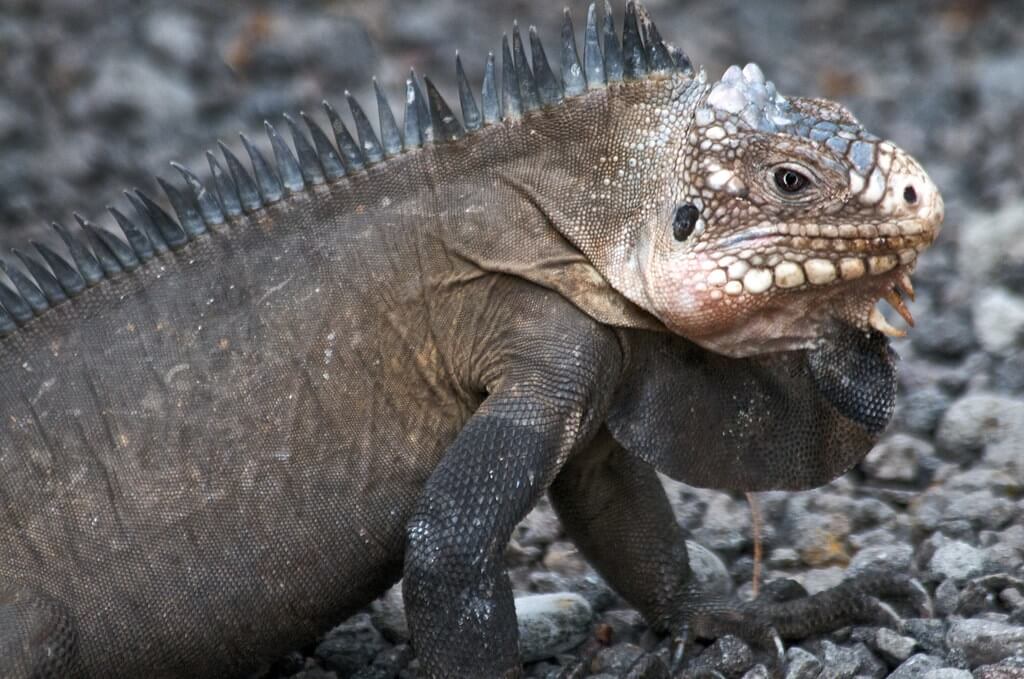
Iguanas are reptiles that can vary significantly in size, measuring from 14 cm to an impressive 1.5-1.8 meters in length. Green iguanas, in particular, can weigh up to 15 kg. Males are distinguished by a larger and more prominent dorsal crest compared to females.
These reptiles have a characteristic dewlap and a row of spines that extend from the back to the tail. Additionally, they have a curious third eye, known as the "parietal eye," located on the top of their head, which is not used for seeing but helps with thermoregulation, the regulation of their body temperature.
Another distinctive feature is the tubercular scales, shaped like spikes, located behind their neck. Iguanas, especially the green iguana, are known for using their long spiny tail as a defense mechanism, capable of delivering strong blows to protect themselves. Despite their intimidating appearance, these creatures are actually shy and peaceful if left undisturbed.
Their vision is very sharp, allowing them to distinguish shapes, colors, and movements at great distances, which is crucial for their survival. They use their vision both to find food and to communicate with each other through visual signals. Their hearing organ, called the tympanum, is located behind the eyes.
The coloration of their skin allows iguanas to blend perfectly into their environment, making them less visible to natural predators. Regarding their diet, they are completely herbivorous, feeding on leaves, flowers, and some fruits.