
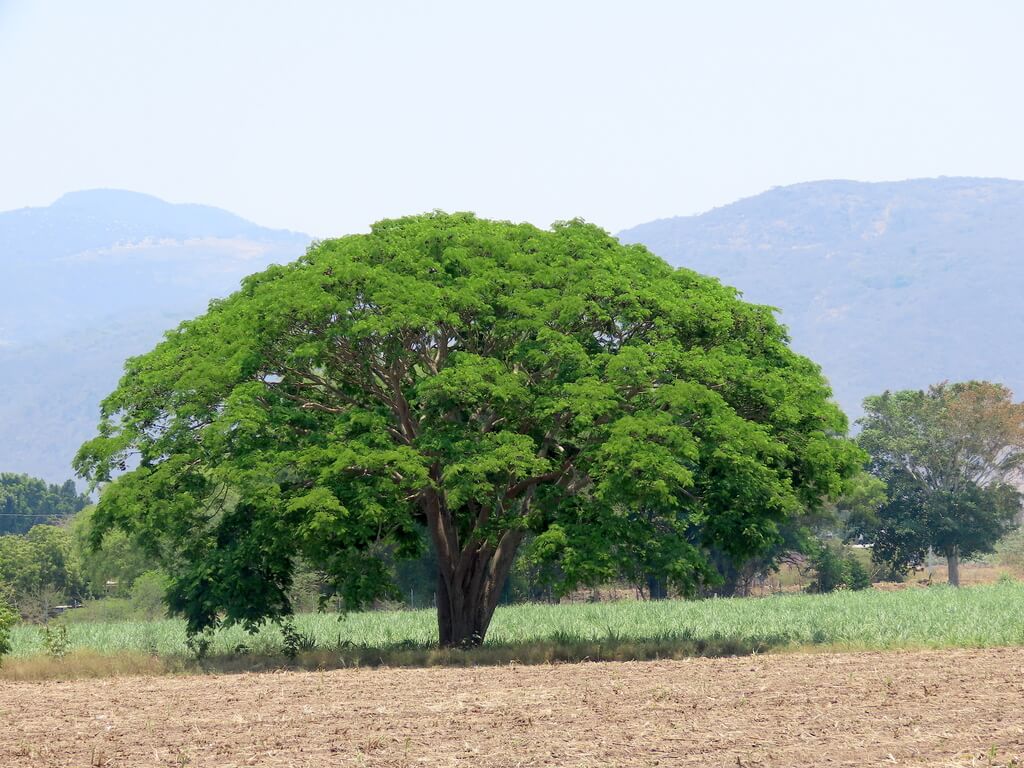
The Guanacaste, National Tree of Costa Rica, is one of the most impressive and noble natural gems of the tropical regions of the Americas. It is distinguished by its majestic canopy, which can extend up to 4 times its diameter, creating an unmistakable visual spectacle.
Named by the ancient Mesoamerican indigenous people as cua-necaxtli, translated into Spanish as "ear tree" due to the shape of its fruits, the guanacaste can reach heights of 30 to 40 meters. In open areas, such as pastures or savannas, its canopy extends thanks to its long branches, making this tree an imposing giant.
The bark of the guanacaste, in a light brown to grayish tone, is unique, with lenticels and small vertical fissures of light brown color, visible from a distance. Its leaves consist of small, light green leaflets. The whitish flowers, grouped in round heads less than 2 cm in diameter, contrast spectacularly with its delicate foliage, attracting bees and insects.
The fruits, dark brown when mature, are covered by a sticky caramel-colored pulp with a penetrating aroma. This strong smell attracts animals like cows and horses, who help disperse its seeds, which are elongated and dark brown with a lighter band on the sides.
The wood of the guanacaste is highly valued for its dark brown color, weight, and durability. It has a good luster and a medium to coarse texture, making it easy to dry and work with. This wood is known for its natural resistance to fire and its ability to withstand attacks from fungi and insects, especially termites. It is used in the manufacture of fine furniture, beams, floors, cabinets, souvenirs, and marine constructions.
An interesting fact is that guanacaste sawdust is toxic to fish and livestock, highlighting another facet of this versatile tree. Additionally, the guanacaste can reproduce massively, forming nearly pure forests on abandoned land.
Other uses include being an excellent shade tree in pastures, serving as forage fruit (although it is abortive for mares), and it is used for medicinal, honey-producing, jewelry, and decorative purposes. The bark and fruits are also used to obtain tannins and soapy substances, demonstrating its wide versatility.
In summary, the guanacaste is not just a tree but a symbol of strength, utility, and natural beauty. It is ideal for those looking for a large ornamental tree to beautify wide spaces.