
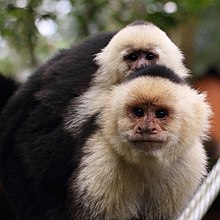
The intelligent and agile White-faced Capuchin Monkey is one of the easiest primates to observe in protected wilderness areas.
Also known in some countries as the Capuchin Monkey, its name comes from the color of its fur, which resembles the habit of a Capuchin monk. Its cream or yellowish fur covers its face, neck, chest, shoulders, and part of its arms, while the rest of its body is black. Its face is pinkish, and it has a long prehensile tail, which provides great agility in the trees. It is a diurnal animal, traveling in noisy groups of up to more than 30 individuals while searching for food at different levels of the forest.
The body of the white-faced capuchin, along with its head, measures approximately 45 cm, while its tail is longer than its body. It weighs between 1.4 and 4.3 kg, with males generally being larger than females.
This primate is extremely versatile in terms of habitat, inhabiting everything from dry and wet tropical forests to mangroves and mature secondary forests. In Costa Rica, it can be found in national parks such as Guanacaste, Santa Rosa, Palo Verde, Carara, Manuel Antonio, Braulio Carrillo, Tortuguero, and Corcovado. Its geographic distribution extends from Honduras to Colombia and Ecuador.
The white-faced capuchin's diet is based on fruits from palm trees and other trees, such as guava, fig, jocote, Guanacaste tree, guarumo, indio desnudo, ceiba, and cornizuelo. It also feeds on insects like cicadas, grasshoppers, ants, butterfly larvae, and beetles, complementing its diet with small animals such as lizards and mammals.