
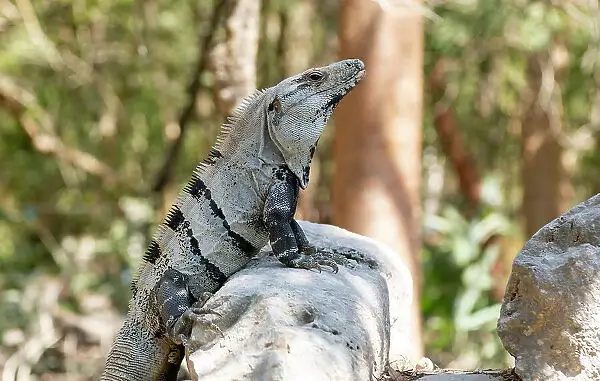
The Ctenosaura similis, commonly known as the garrobo, is a large species of lizard belonging to the Iguanidae family, native to Central America. It is famous for being one of the fastest lizards in the world relative to its size, capable of exceeding 30 km/h and running on its two hind legs. This species has been introduced to various Caribbean islands and parts of the United States, where it has thrived remarkably.
The garrobo is the largest species in the genus Ctenosaura, with a body length exceeding 45 cm, in addition to more than 45 cm of tail. Males tend to be significantly larger than females.
There is a marked sexual dimorphism in this species, which facilitates the identification between males and females. Males are more robust, have a basal fold resembling a non-inflatable dewlap, and a conspicuous dorsal crest with spiny scales. They also display well-defined black bands along the sides of their body. Females, on the other hand, are smaller and less robust, with a less visible or non-existent dorsal crest. The dark bands on females are usually less intense or smaller.
The garrobo is primarily herbivorous, feeding on fruits and other plant parts, although it has also been observed hunting small animals. Occasionally, it feeds on mice, toads, bird eggs, and even small birds.